7 Rules for Wearing Pseudo-Military Streetwear Without Looking Like a Costume
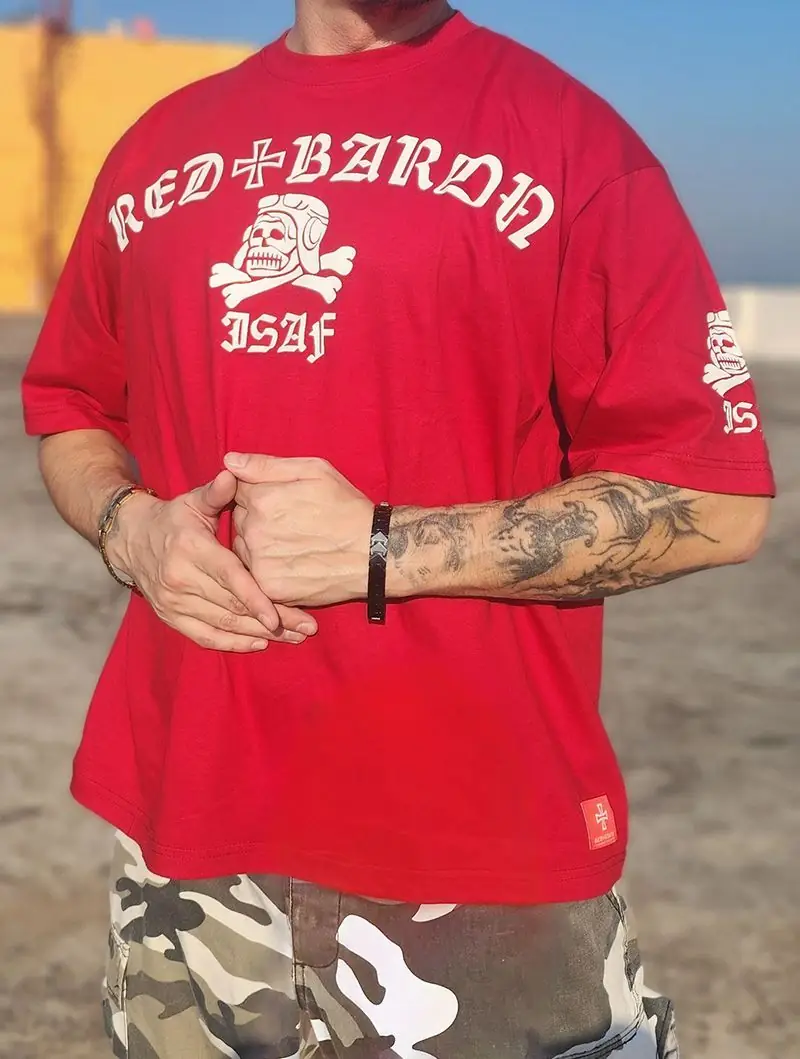
Pseudo-military style borrows the language of uniforms (olive and sand colours, stencil lettering, badges, bomber-crew imagery) and turns it into everyday clothing. The risk is obvious: go too far and the outfit looks like fancy dress. These seven rules keep it on the right side of that line.
One statement, everything else quiet
Pick a single item with strong military or historical character and let it lead. A graphic T-shirt in olive drab or red is enough. Pair it with plain dark trousers and simple shoes. If your shirt, trousers, jacket and cap all carry military details, the look stops being style and becomes a uniform.
Stay inside a three-colour palette
Uniform colours are limited, and your outfit should be too. Choose a base (black, navy or dark grey), a field colour (olive, tan or desert sand) and one accent (white or red). Anything beyond three colours starts to look noisy.
Mind the proportions
Relaxed, slightly oversized tops look current when the lower half stays clean. If the T-shirt is roomy, choose straight or tapered trousers. If you wear cargo trousers with large pockets, take a more fitted top. Balance is what separates streetwear from baggy clothes.
Let the print do the talking
Graphic details such as a bomber-crew skull, a medieval war pig or a sleeve patch carry the whole message. That means your other pieces should be plain. A red and white print like the Red+Baron ISAF T-shirt works best with no other graphics in sight.
Treat patches and badges as punctuation
One patch is a detail. Five patches are a statement you probably did not intend. If the shirt already has a sleeve patch or emblem, skip extra pins and badges on the jacket or the cap.
Choose shoes that ground the outfit
Simple boots or plain sneakers keep a graphic outfit anchored. Avoid combat-style boots with every other military element, because that combination tips the look back toward costume.
Wear it like you mean it
The last rule is attitude. Pseudo-military streetwear is a style choice, not a role. Clothes fit better when you are relaxed in them, so choose a size that is comfortable and a print you genuinely like.
Rules in practice: three complete outfits
Rules are easier to remember with examples. Here are three simple combinations that follow all seven.
- City day. An olive drab graphic T-shirt, black straight trousers, plain black sneakers and a dark cap. One statement (the shirt), three colours (olive, black and white soles), no extra badges.
- Warm weather. A tan or desert sand T-shirt with a dark graphic, light trousers or shorts, white sneakers. The print is the only detail, and the palette stays light.
- Evening. A red graphic tee under a plain dark jacket, dark jeans and simple boots. The jacket calms the red; the boots anchor the outfit.
Fabrics and textures
Military clothing was designed to be practical, which is why cotton, canvas and ripstop appear again and again in this style. Choose a few honest textures rather than many different ones. A soft cotton T-shirt, a slightly stiff pair of trousers and a canvas cap already create enough variety. Avoid shiny synthetic fabrics when the rest of the outfit is matte; they pull the look away from its field-clothing roots.
Adjusting the look through the seasons
- Spring: olive and light denim, a thin jacket over a graphic tee.
- Summer: tan, desert sand and white, with shorts and a cap for the sun.
- Autumn: olive, dark grey and a hint of red, layered with a hoodie.
- Winter: dark layers, with the graphic tee visible under an open coat.
A short glossary of the style
- Olive drab: a dull, brownish green used widely in field clothing.
- Desert sand and tan: light, warm shades inspired by clothing for dry climates.
- Stencil lettering: blocky letters with gaps, borrowed from equipment markings.
- Insignia and patches: badges that show a unit, rank or symbol, used in streetwear as graphics.
- Pseudo-military: clothing inspired by military looks without being real uniform.
Who this style suits
The look is flexible. It works on people who like a clean, practical wardrobe and on those who enjoy bold graphics. It suits casual days, weekends, travel and relaxed evenings. It is less suitable for formal settings, where plain tailoring is the better choice.
Where the style comes from
Military clothing has influenced everyday wear for generations. Practical garments designed for the field, such as field jackets, cargo trousers, canvas bags and boots, moved into civilian wardrobes because they were durable and comfortable. Later, designers started borrowing only the visual language: the colours, the lettering and the badges. That second step is what we call pseudo-military. It keeps the attitude and drops the obligations.
How the pieces fit together in a week
A good test of any style is whether it works for a whole week, not just one photo. With three graphic T-shirts, two pairs of trousers and one jacket, you can build seven different outfits without repeating the same combination. The key is to alternate loud and quiet days: a graphic tee one day, a plain tee the next, so the style never feels forced.
Questions to ask before you buy a piece
- Will I wear it with at least three things I already own?
- Is the colour one I will still like next year?
- Does the fit work with the relaxed silhouette of this style?
- Is the graphic something I can explain with a few words?
If the answer to all four is yes, it is a good purchase.
Common mistakes to avoid
- Wearing military trousers, jacket, boots and cap together.
- Choosing a size that is too tight; the style depends on a relaxed fit.
- Adding too many patches, pins and chains.
- Ignoring shoes. The wrong pair can undo an otherwise good outfit.
- Forgetting grooming. Clean, pressed clothes make casual pieces look intentional.
Where to start
The T-shirt line from Red+Baron is built around exactly this idea: bold, one-of-a-kind graphics in olive drab, red, tan and dark grey, handmade from upcycled materials. See the designs in the collection and start with a single piece.
FAQ
Can I wear military-inspired clothing every day?
Yes. Use one statement item and keep the rest of the outfit neutral, and the style works for daily wear.
What colours are the safest to start with?
Olive, black, tan and white combine easily and suit most skin tones.